Buyer Guides · Specifications
Are Ceramic Planters Waterproof?
Drainage, Saucers and Water-Containment Requirements
A ceramic planter should not be treated as waterproof simply because it has a glazed finish or no visible drainage hole. Professional buyers need to define how the product will be used, where water should go and what evidence is required before approving it.
Start by distinguishing the decorative outer container from the container holding the plant and growing medium. Then specify drainage, liners, saucers and water containment for the actual product configuration.
1. Define whether the product is a cachepot or a direct-planting container
A decorative cachepot holds a separate nursery pot or planting container. Its role may be primarily visual, but buyers still need to decide whether water will enter the outer container during watering or display. If the inner pot will be removed for watering, describe that handling method and whether any residual water must be contained after it is returned.
A direct-planting container holds the growing medium and plant directly. Specify the intended planting and watering arrangement, including how excess water will leave the container or be managed within the agreed system.
A catalog label such as “drop-in” or “direct plant” is a starting point for discussion. Confirm usable internal dimensions, plant fit and drainage rather than assuming that the label establishes the complete configuration.
2. Separate drainage from water containment
Drainage describes the intended route for water to leave the planting container. Water containment describes where that water must remain and which surrounding surfaces must stay dry.
For example, a ceramic pot with drainage holes may release water into a separate saucer. A cachepot may instead need to contain water draining from an inner nursery pot. These are different requirements and should be reviewed separately.
“Leakage-resistant” does not define a guaranteed watertight result. Ask what the term means for the selected product: under which conditions, for how long and with what acceptance criteria. Where no water escape is acceptable, state that requirement explicitly and agree how it will be verified.
3. Specify drainage holes and the complete watering arrangement
For a conventional direct-planting program, identify the required drainage-hole number, location and dimensions for review. Confirm whether holes are supplied as standard, require a product modification or are absent from the selected version.
If a plug or closure is requested, specify whether it is included and whether the closed configuration must meet a separate water-containment requirement. Closing a hole should not be treated as proof that the completed planter is watertight.
For cachepots, confirm whether the outer container is intended to have drainage holes. Describe how water from the inner pot will be handled, including any liner, saucer or removal-for-watering procedure. Include the intended water-removal procedure and any related handling or care instructions in the purchasing brief, and request confirmation for the selected configuration.
4. Record glazed and unglazed surfaces
Specify the finish on the interior, exterior and base, including any areas intended to remain unglazed. An exterior photograph may communicate appearance without showing the surfaces that will contact water.
Do not assume that “glazed,” “matte,” “stoneware” or another material or finish description establishes water-containment performance. Ask the supplier to confirm the finished product’s construction and the evidence available for the intended use.
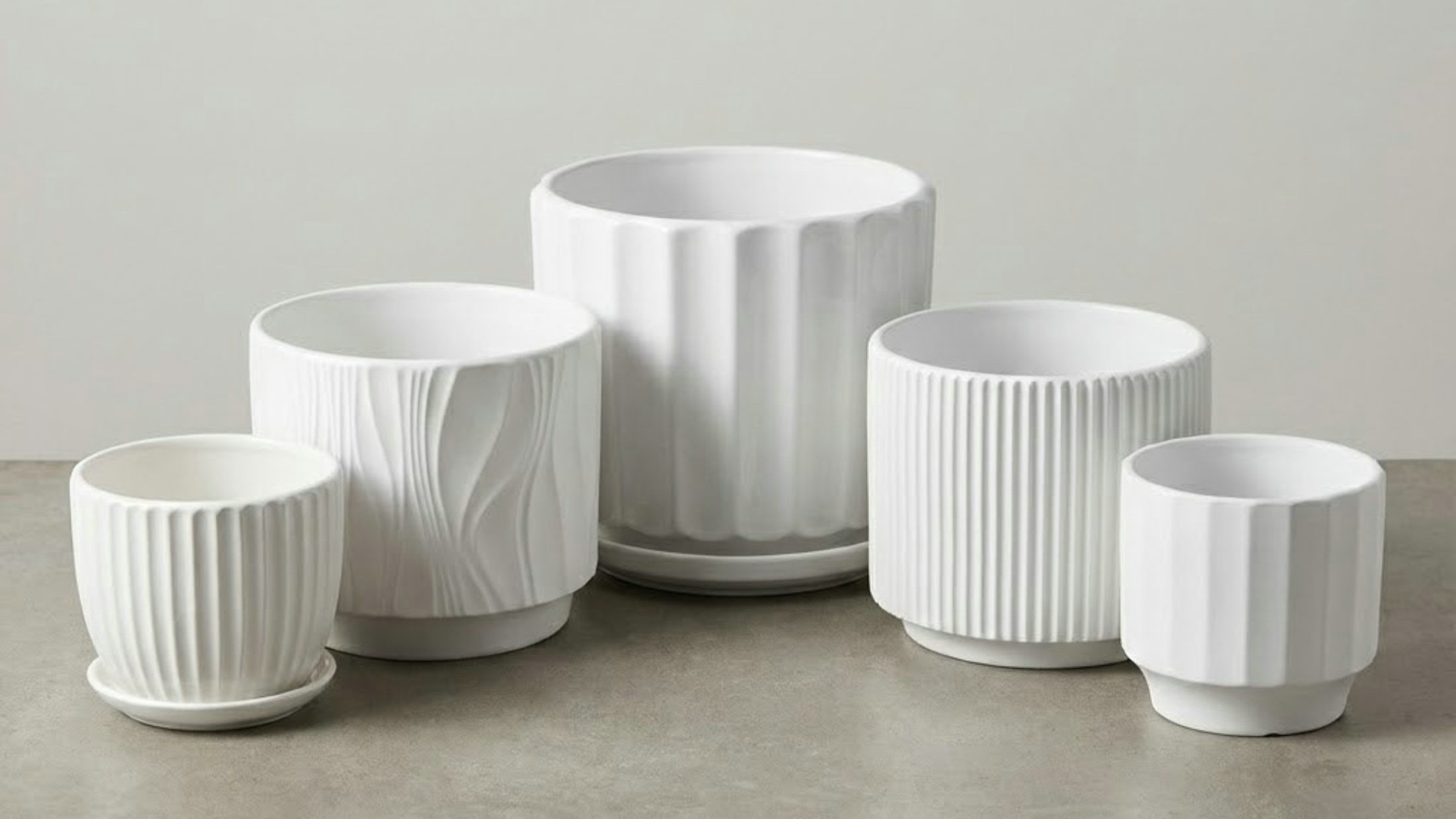
For appearance references, compare Stitched Edge Ceramic Planters and Matte Wave Ceramic Planters. Their photographs and recorded dimensions support design review; they do not establish waterproofing, drainage configuration or saucer inclusion.
5. Specify plastic liners and saucers as separate components
A plastic liner and a nursery pot are not interchangeable specifications. Confirm whether the proposed insert has drainage holes, whether it is intended to contain water and how it fits inside the ceramic piece.
Record the liner’s usable dimensions, intended water level and removal requirements. If it is intended to provide containment, evaluate the liner in the supplied configuration rather than assuming that its plastic material guarantees performance.
For a saucer, confirm fit, usable capacity and the intended watering arrangement. Review the saucer’s own containment requirement separately from the planter’s drainage requirement. Specify whether liners, saucers and plugs are included, optional or quoted separately.
Where furniture, shelving or flooring must remain dry, identify those surfaces in the brief. Do not assume that an accessory or protective pad establishes that requirement.
6. Agree product-specific sample verification
Ask Florinia and its manufacturing partners what sample verification is appropriate and available for the selected product. Agree the method before using a sample result as an approval basis.
A water-containment review should identify:
- The exact item, size, finish and supplied accessories.
- Whether the ceramic piece, liner, saucer or complete assembly is being evaluated.
- The water level, exposure duration and relevant use conditions.
- What will be observed, such as droplets, seepage or moisture beneath the assembly.
- The acceptance criteria, sample quantity and responsibility for recording results.
Conduct the review in a controlled location where escaping water can be collected. A drainage hole intentionally releasing water is different from unintended leakage through another part of the assembly.
Record the conditions and results. A passing sample supports approval under those conditions; it does not establish unlimited watertight performance or automatically cover other sizes, finishes and production versions.
7. Put the requirement into the written specification
Replace a general request for “waterproof pots” with a description of the intended use and a measurable requirement.
The following example illustrates a buyer-requested acceptance criterion for supplier review. It is not a statement of verified product performance or a general Florinia waterproofing guarantee:
Decorative outer cachepot for a specified nursery pot. Confirm the supplied drainage configuration and whether a removable liner is required. Buyer-requested criterion: no water escape onto the display surface under the agreed sample-test conditions. Record the water level, duration, assembly and acceptance criteria before approval.
The supplier must confirm whether the selected product can meet the requested criterion and what verification supports that confirmation.
For a drained direct-planting container, specify the intended discharge into a matching saucer and define the saucer’s containment requirement separately.
Include the approved sample reference, component list, test record and any limitations or care instructions. Ask whether changes to the body, finish, drainage configuration or accessories require renewed review. Any warranty or commercial terms must be confirmed separately; they are not established by a photograph, product label or sample check alone.
Before you send your RFQ
Identify whether the planter holds a nursery pot or is planted directly. Mark drainage and water-containment requirements separately, list the required accessories and explain which surfaces must remain dry.
Use the ceramic planter RFQ checklist to organize the remaining dimensions, finish, quantity, packaging and delivery details. Mark undecided requirements as questions for review rather than agreed specifications.
Put your brief to work
For a custom ceramic program, review ceramic planter development and bring your intended-use requirements, references and verification questions to the discussion.
For selected existing collections, review the ceramic wholesale purchasing options. Confirm the configuration, accessories, availability and terms for the selected items.